Leisure Match
A smart application to discovery of new activities, overcome boredom, and foster social connections, especially in unfamiliar locations.
Year :
2025
Industry :
Tech-Entertainment
Project Type :
Individual
Project Duration :
4 weeks
Project Overview
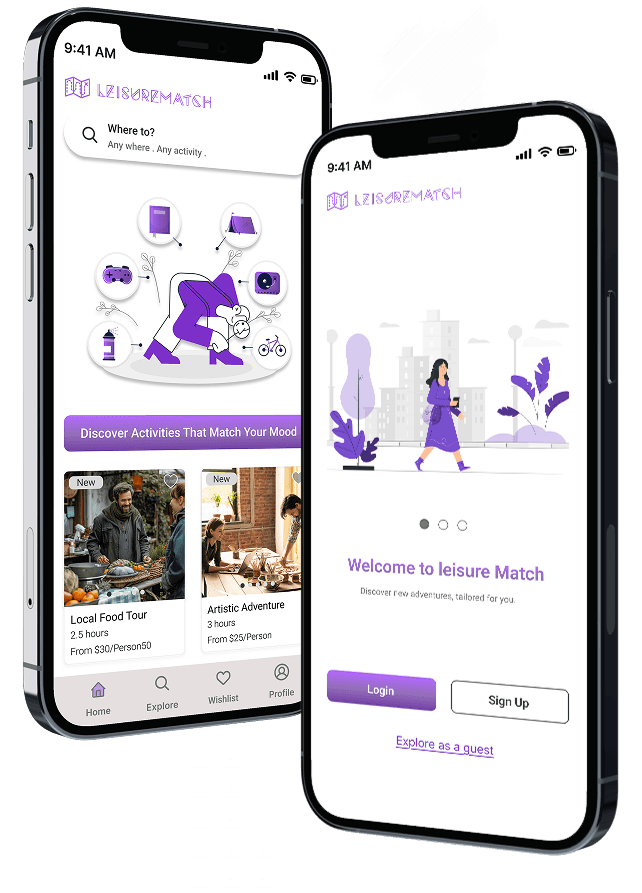
Leisure Match is an app that helps users, especially newcomers, overcome boredom and homesickness by exploring local activities. Its innovative Mood Detector questionary tailors activity recommendations to users' moods and interests, offering a personalized and engaging way to connect with their surroundings and enjoy new experiences anywhere in the United State.
View Prototype
Read More
Problem statement
Problem statement
Newcomers to the USA often experience high rates of depression and homesickness during their free time.
A contributing factor is they are unfamiliar with local outdoor activities.

Project Scope
Project Scope
Timeline
5 Months
(Part time)
5 Months (Part time)
Individual
Self-started Project in collaboration with some peers.
Role
UX Researcher UX/UI Designer
Role
UX Researcher UX/UI Designer
Tools
Qualtrics, Figma, FigJam, Photoshop, Illustrator, Open AI
Tools
Qualtrics, Figma, FigJam, Photoshop, Illustrator, Open AI
User problems
User problems
1.
Increased Boredom and Homesickness
1.
Increased Boredom and Homesickness
2.
Difficulty Finding Mood-Matching Activities
2.
Difficulty Finding Mood-Matching Activities
3.
Providing innovative solutions
3.
Providing innovative solutions
Objective & Goals
Objective & Goals
understanding the challenges:
Overcoming the challenges newcomers face in discovering local activities to make the most of their leisure time.
understanding the challenges:
Overcoming the challenges newcomers face in discovering local activities to make the most of their leisure time.
Providing innovative solutions:
Helping newcomers find suitable local outdoor locations and activities that align with their moods and personalities to counter boredom and homesickness.
Design Process
Design Process
01.
Discovery
User Research User Interview Entrant Analysis

02.
Define
User Persona User Journey Map

03.
Ideate
Brainstorming Card Sorting Impact /Effort Matrix
03.
Ideate
Brainstorming Card Sorting Impact /Effort Matrix
04.
Design
Paper Wireframes Flow chart Design System
04.
Design
Paper Wireframes Flow chart Design System
05.
Develop
Mid-Fed Design Prototype Nest Steps

Discovery
Discovery
I conducted the qualitative and quantitative research to better understand how newcomers maintain a positive mood and emotional well-being by engaging in activities that alleviate boredom .
Survey
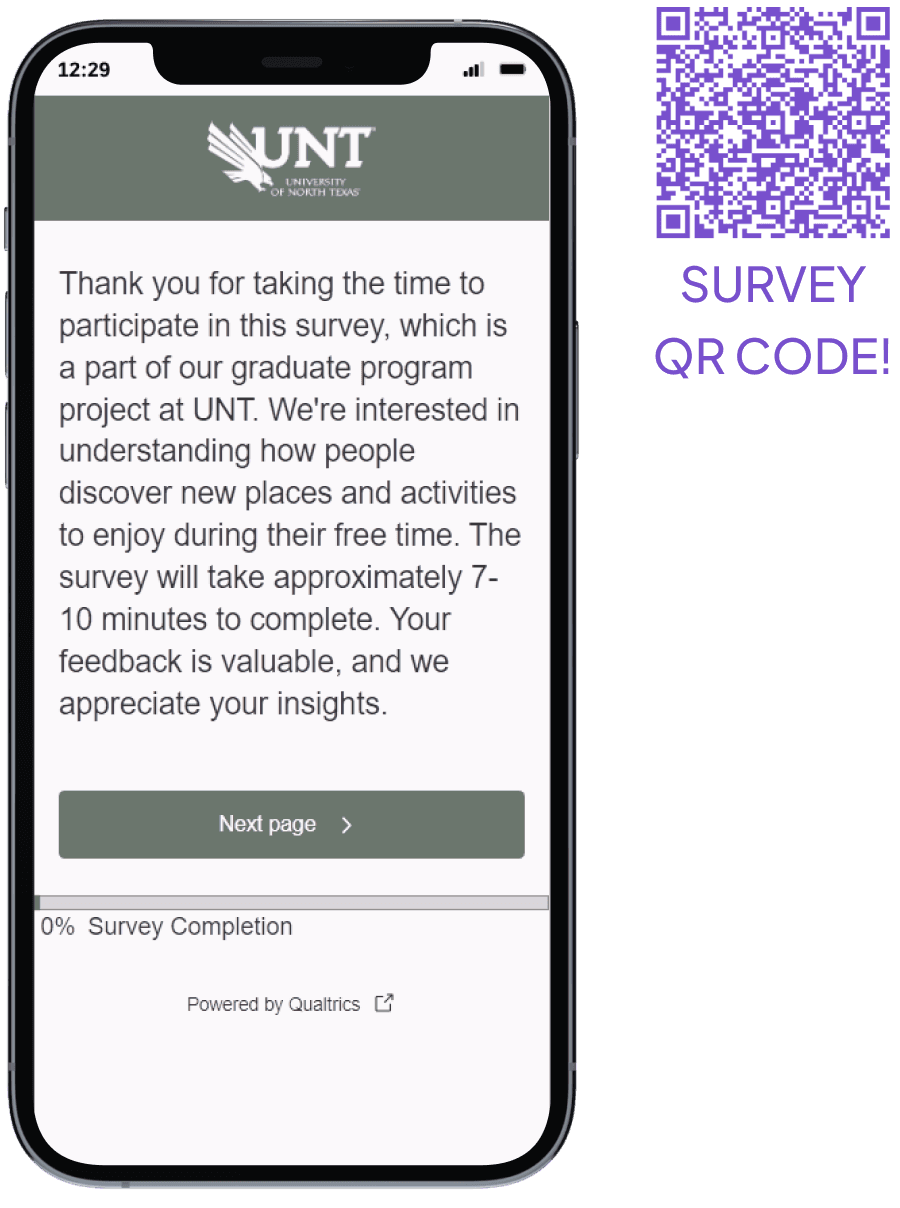
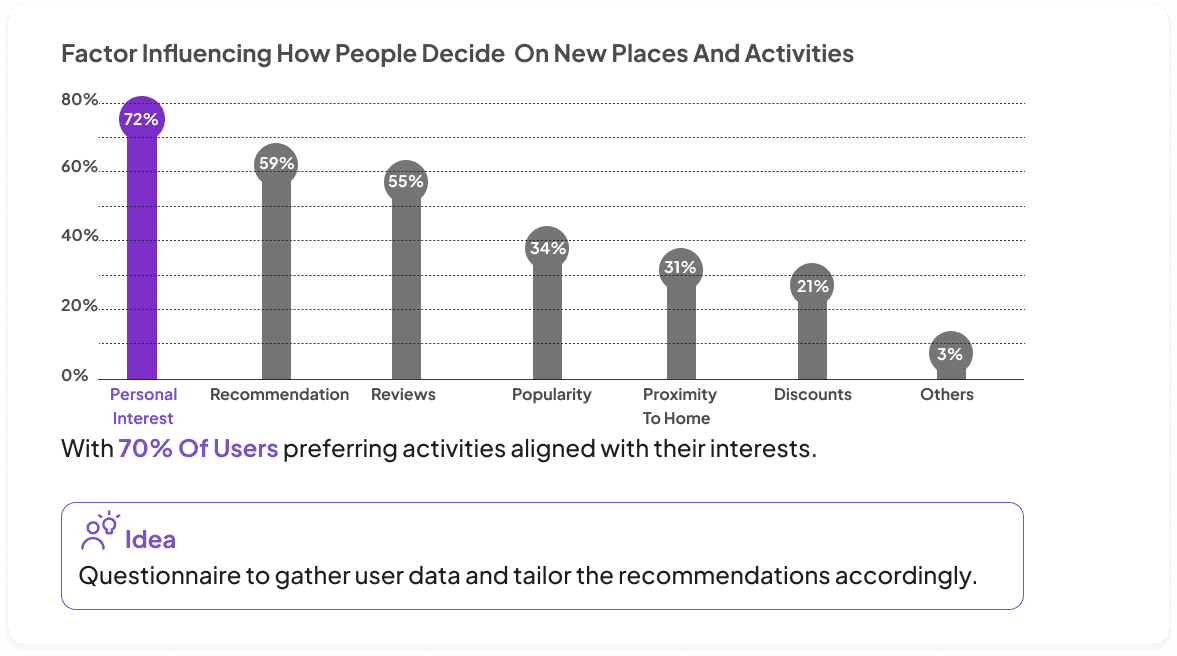
An online survey was conducted with 35 participants aged 18 to 54, all living in North America.
The goal was to gain insights into user behavior and preferences.
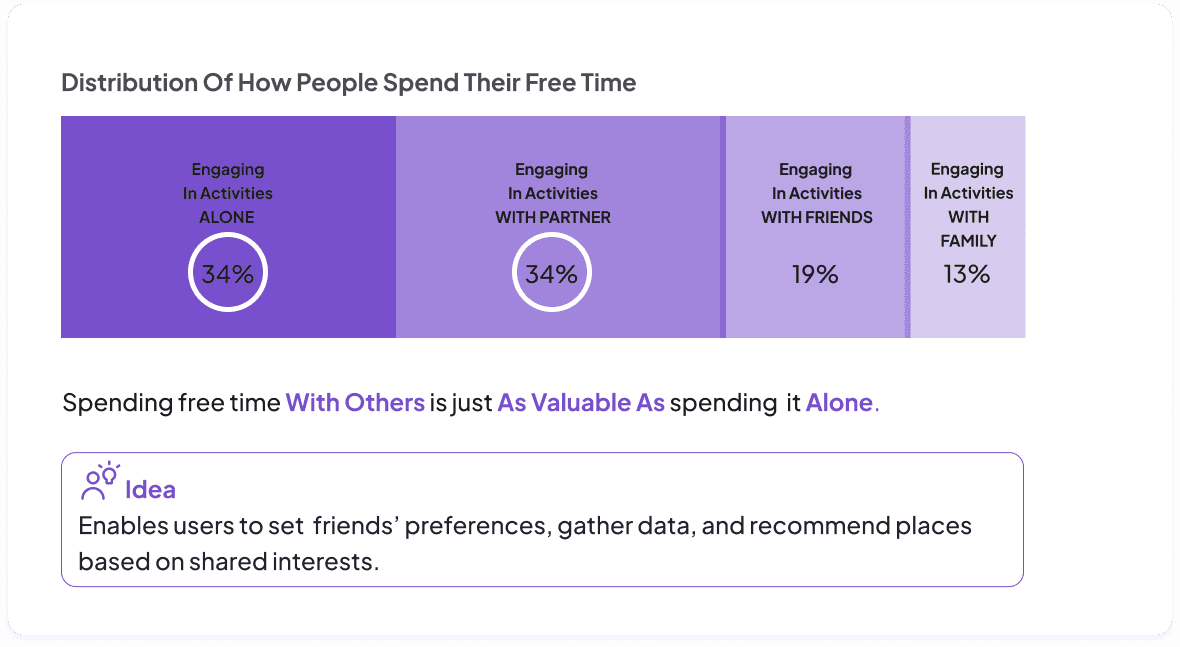
The survey focused on how individuals spend their free time and discover new activities.
It consisted of 16 questions in different formats. Qualtrics was used to create and analyze the survey.
An online survey was conducted with 35 participants aged 18 to 54, all living in North America.
The goal was to gain insights into user behavior and preferences.
The survey focused on how individuals spend their free time and discover new activities.
It consisted of 16 questions in different formats. Qualtrics was used to create and analyze the survey.
Interview
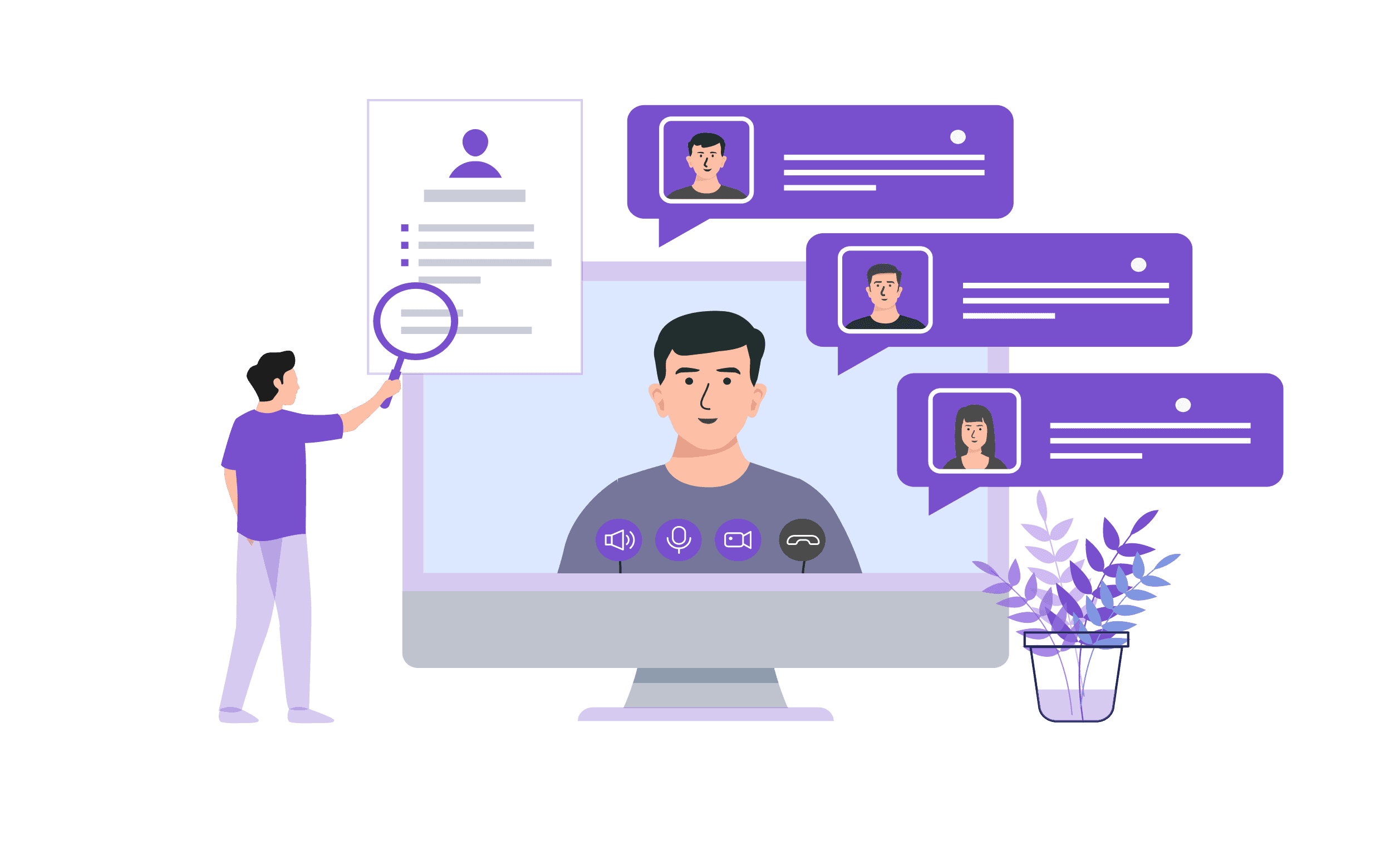
Gather insights on users' moods and interests to recommend activities.
Offer personalized suggestions.
Design group activities that align with the preferences of all members.
Enable users to capture the essence of locations or activities.
Assist users in finding partners for activities.
Define
Define
Persona
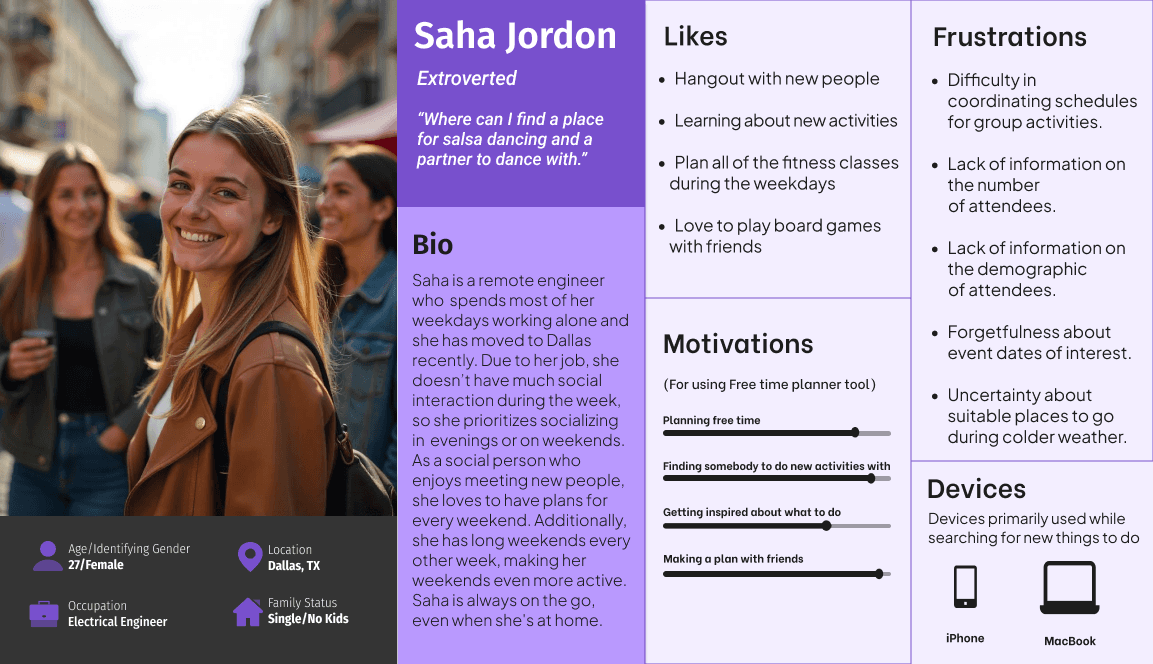
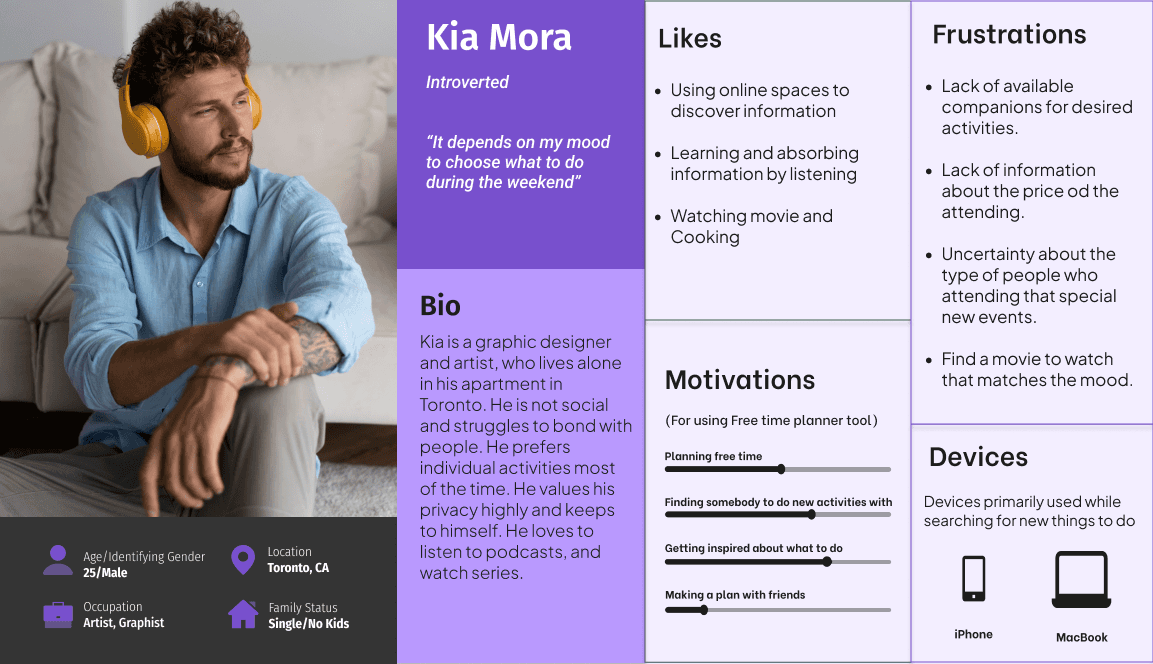
Insights from the research informed the creation of user personas, highlighting key needs and pain points. The research identified two primary target audiences: extroverted and introverted individuals, both eager to explore new activities during their free time, albeit with different preferences and approaches to engagement.
User Journey Map
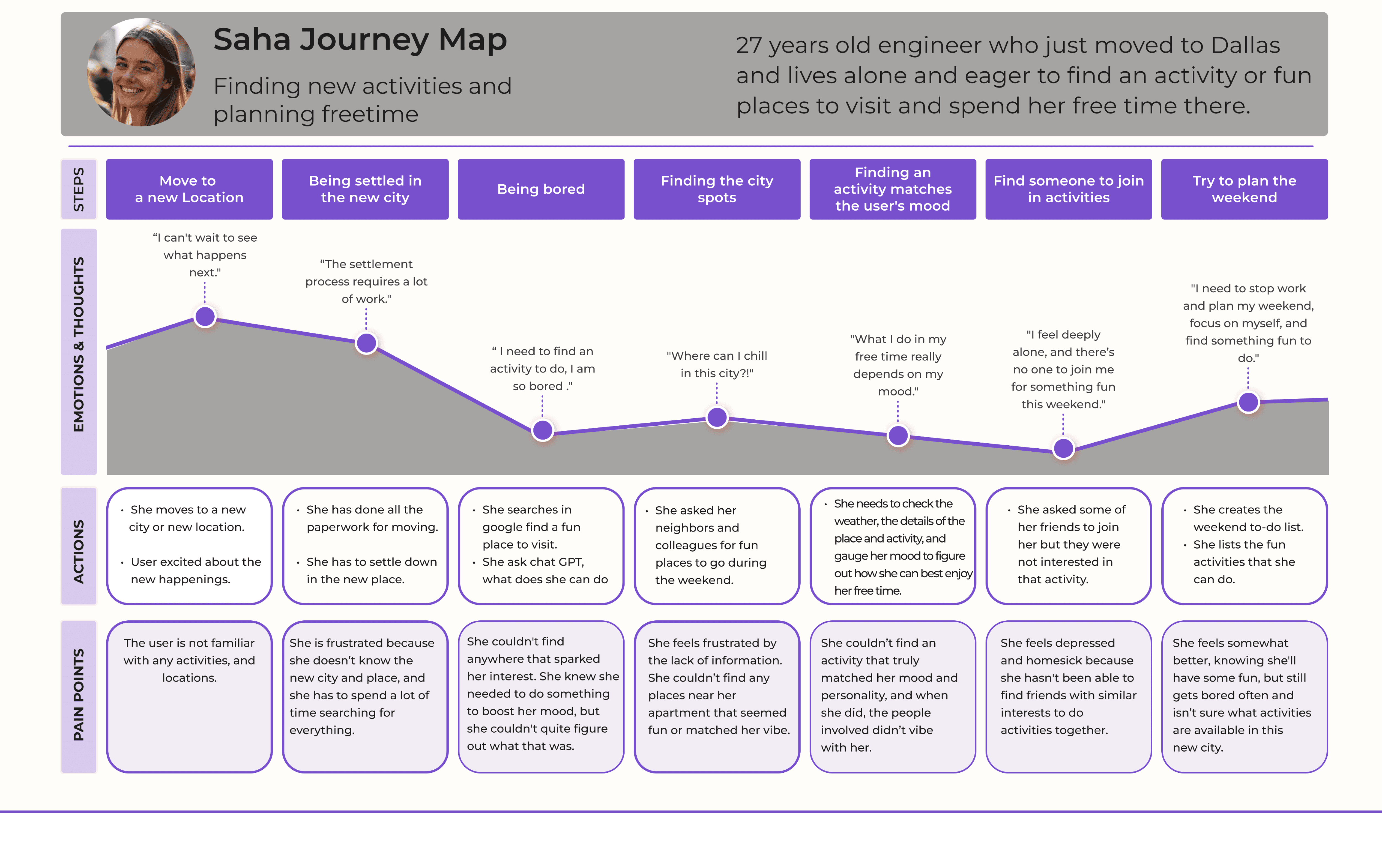
The user journey map illustrates Saha's experiences. Living alone and eager to explore her new surroundings, Saha faces challenges in finding engaging activities and meaningful social connections. The journey highlights her emotional highs and lows as she navigates boredom, unfamiliarity, and homesickness, all while seeking activities that align with her mood and interests.
Key Takeaways
Initial Excitement Fades Quickly: While Saha starts her relocation with excitement, the settlement process, paperwork, and lack of familiarity with the city quickly dampen her enthusiasm.
Difficulty in Finding Personalized Activities: Saha struggles to discover activities that align with her personality and mood due to limited localized recommendations and overwhelming generic options online.
Social Isolation as a Barrier: A recurring pain point is the lack of like-minded individuals to share activities with, leading to feelings of loneliness and homesickness.

Ideate
Ideate
Brain Storming
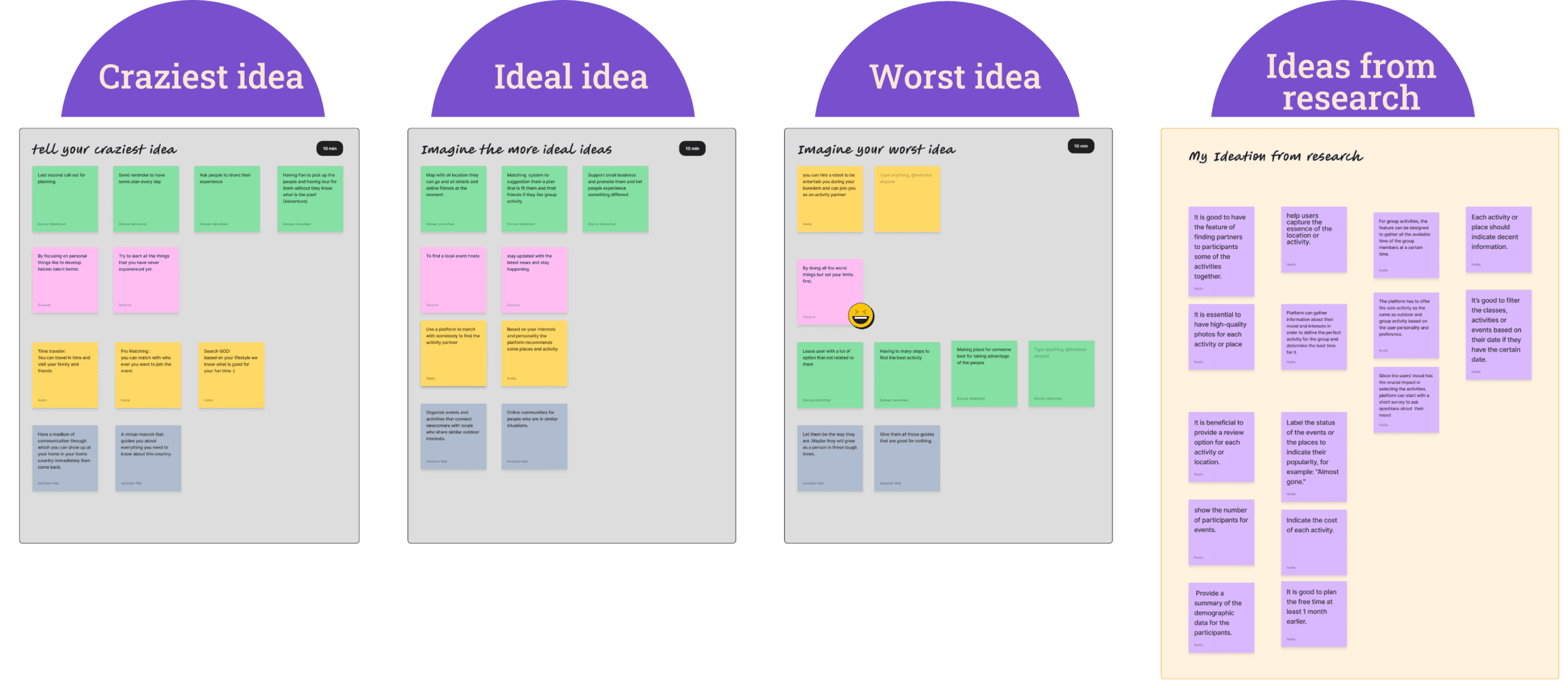
The brainstorming session was conducted with three peers and lasted one hour. It was guided by insights from user research and a problem statement, focusing on generating innovative solutions to address the identified user needs and pain points.
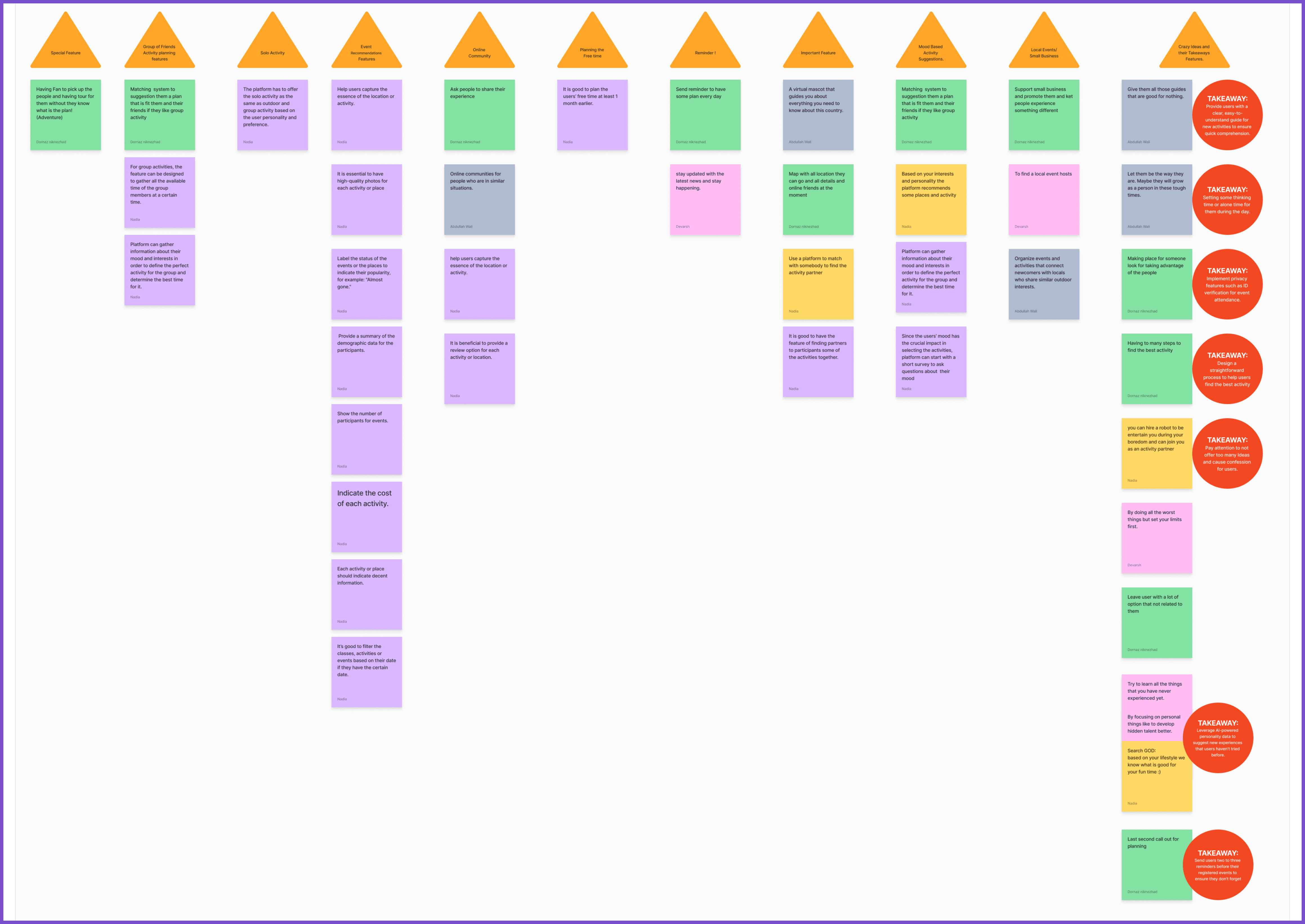
Affinity Diagram of Ideas:
Key Takeaways
Mood-Based Matching: Leverage user mood detection to suggest personalized activities or experiences.
Partner Matching: The feature that connects users with similar interests to participate in activities together.
Last-Minute Callouts: Create alerts for last-minute plans, encouraging spontaneity and reducing boredom.
AI-Powered Suggestions: Use AI to analyze user habits and provide hyper-personalized recommendations.
Group Events: Support small-group activities to help users meet people and form connections in local areas.
Event Details: Include high-quality photos, cost estimates, and a summary of the demographic data for events or activities.

Impact/Effort Matrix Results
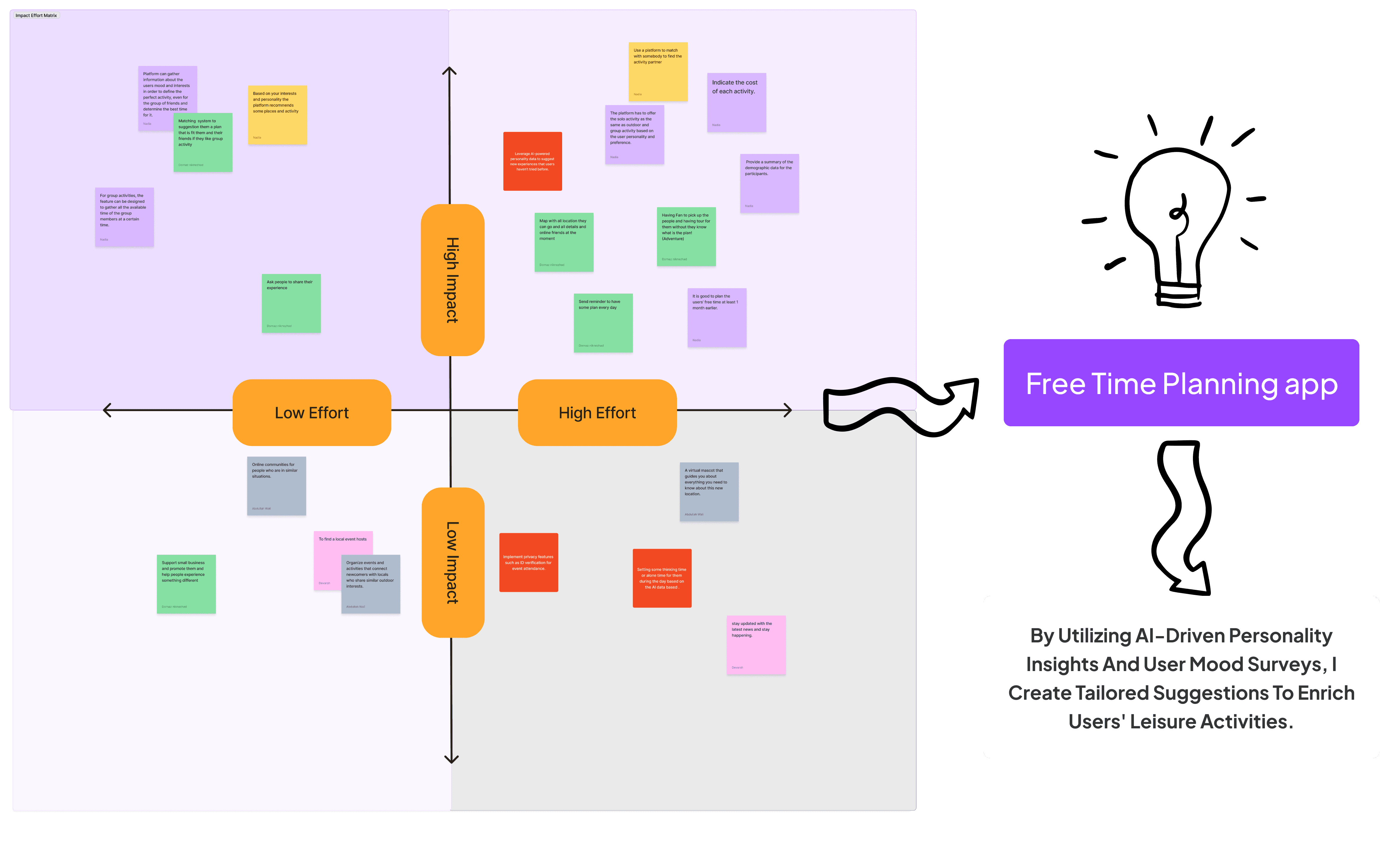
To finalize the most effective solutions, we delved into the Impact/Effort matrix. This powerful tool helped me prioritize the features for the Leisure Match, ensuring focus on what truly makes a difference!
High-impact, low-effort features such as mood-based activity recommendations, community sharing, and AI-driven insights were identified as primary deliverables.
Design
Design
Sketches
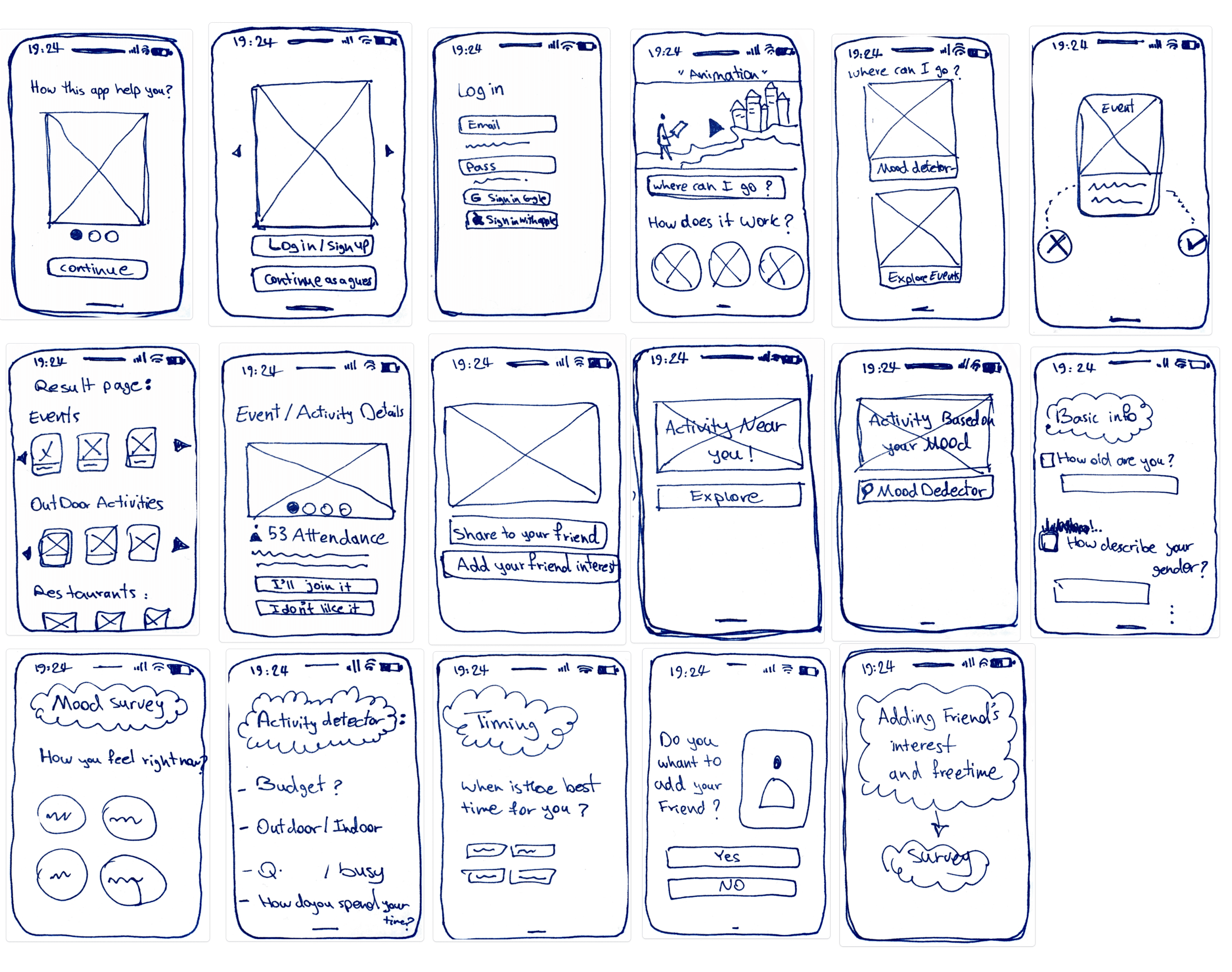
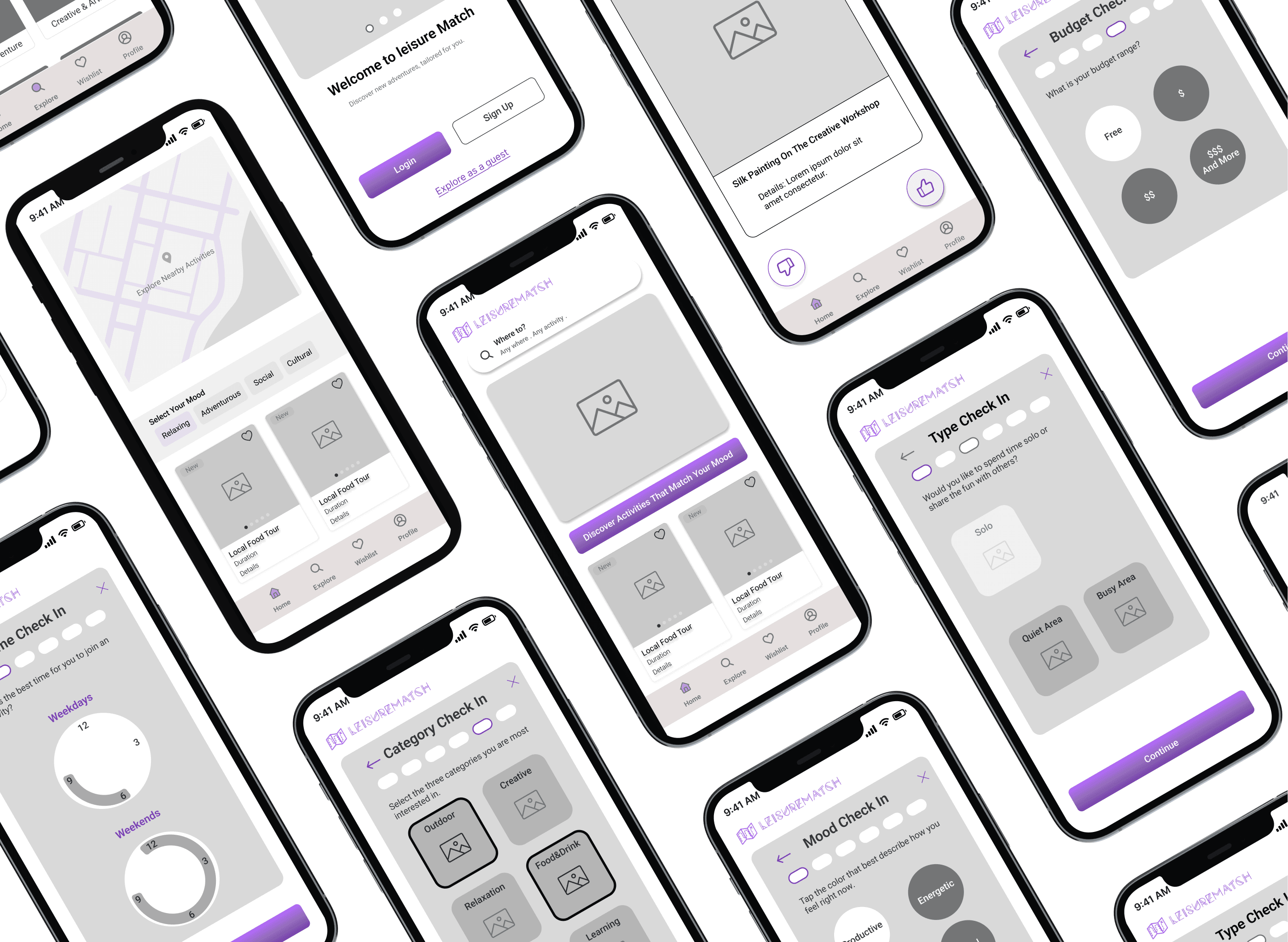
As part of the design process for the Leisure Match project, the low-fidelity sketches serve as the foundation for exploring key features and functionality of the application. These wireframes are designed to translate user insights and brainstorming outcomes into tangible solutions, focusing on simplicity, usability, and alignment with user needs.
Card Sorting
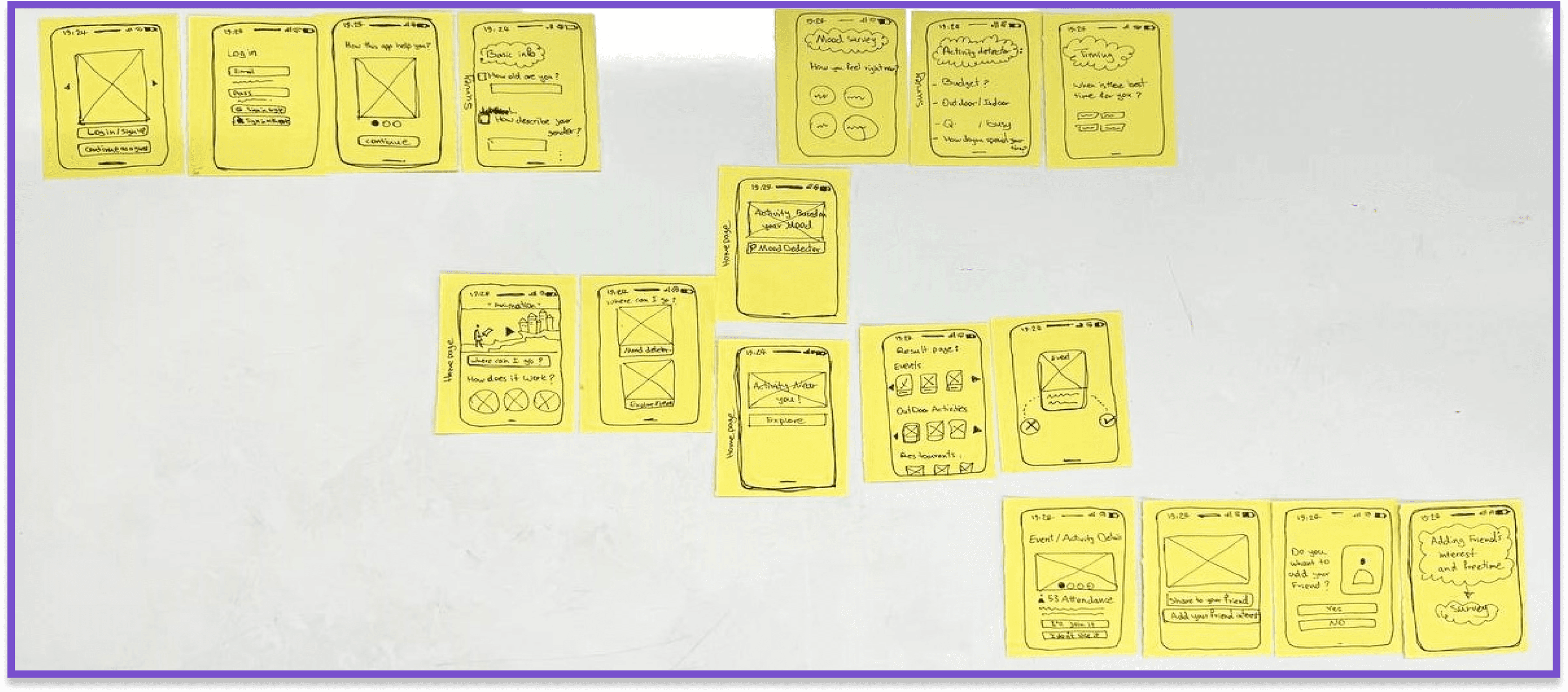
Five card sorting sessions were conducted with target users, where they were asked to organize the wireframes in an arrangement that felt most intuitive and logical to them. This card sorting helped me to understand user preferences and ensure the app's structure aligns with their natural thought processes.
Final Flow:
Flow Chart
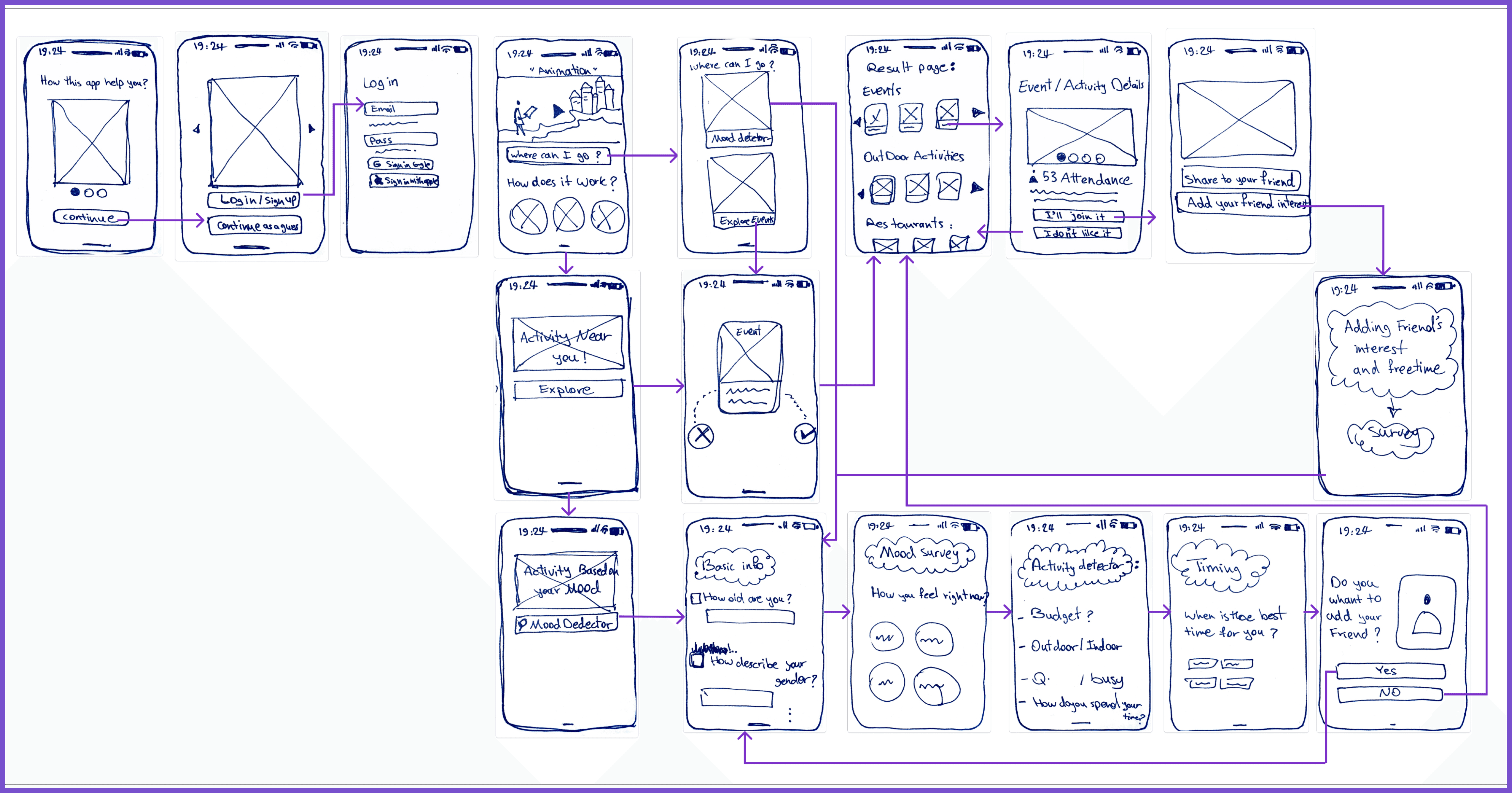
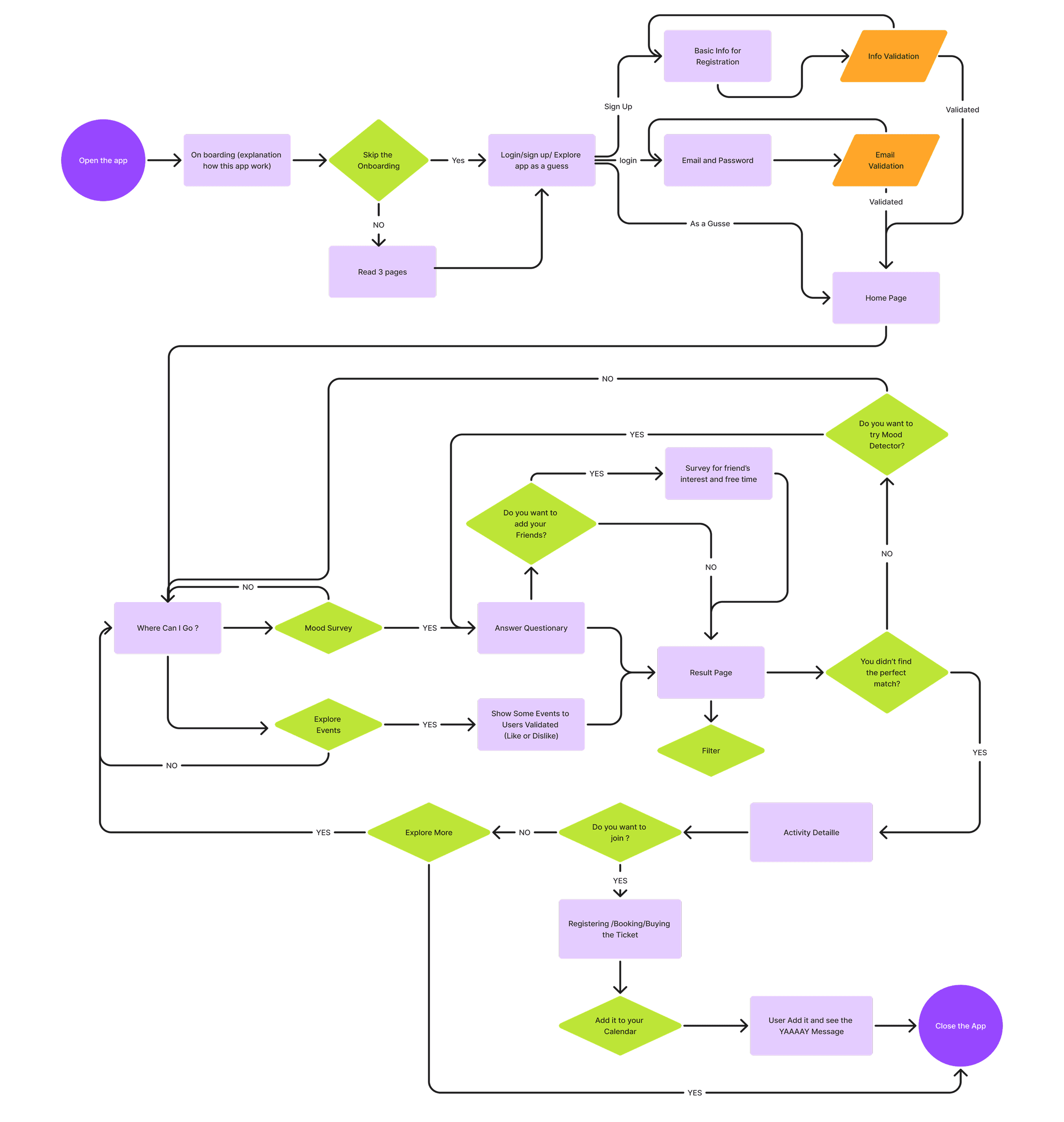
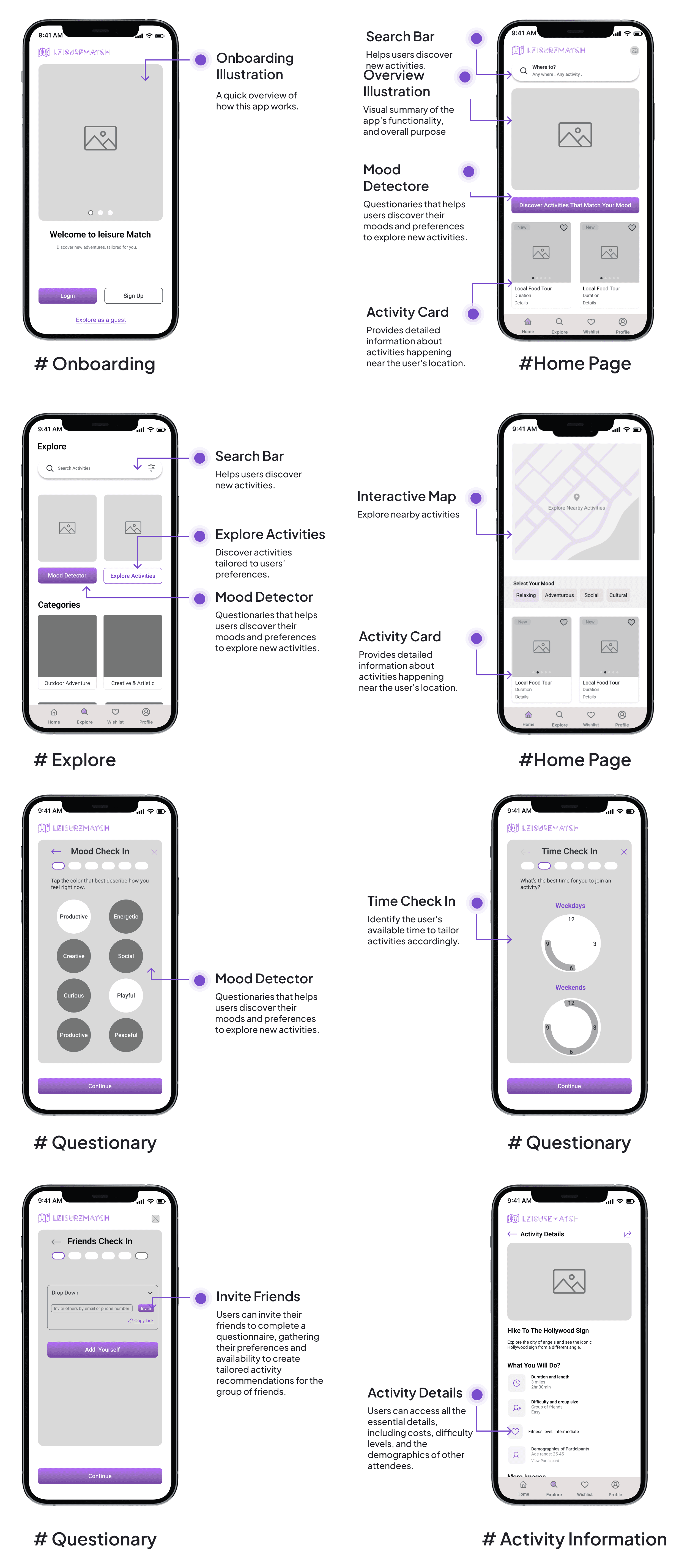
The flowchart showcases how Leisure Match simplifies the process of finding new activities, making it intuitive, engaging, and personalized. By incorporating features like mood detection, collaborative planning, and filtering tools, it ensures users can efficiently discover activities aligned with their interests and preferences, whether alone or with friends.
Develop
Develop
Design System

This design system serves as the foundation for the Leisure Match application, ensuring a cohesive, consistent, and user-friendly interface throughout the platform. It consolidates essential design elements and guidelines to streamline the development process and maintain visual harmony across all features. This system ensures scalability and adaptability while enhancing the overall user experience.
Mid-Fidelity Designs:

Key Learning
Throughout this process, I realized that my primary interest during the research phase lies in conducting interviews and engaging in meaningful conversations about the challenges people face. I aim to deepen my empathy by actively participating in these discussions.
Delving into personal stories and real-life experiences has shown me how valuable these insights can be in sparking creativity and uncovering effective solutions.
During the design phase, brainstorming was an incredibly fulfilling experience. I learned that even the most unconventional ideas can lead to highly effective solutions.
I’ve learned how users’ mental models can differ from mine, highlighting the need to consider their perspectives through usability testing at every design stage.
Next Step
In the early stages, I will create high-fidelity wireframes and conduct a second round of usability testing.
Based on the research, one of the key features is enabling users to find partners for activities. I will design this feature to enhance the app’s uniqueness and user experience.
Begin designing the web platform for Leisure Match.

Leisure Match
A smart application to discovery of new activities, overcome boredom, and foster social connections, especially in unfamiliar locations.
Year :
2025
Industry :
Tech-Entertainment
Project Type :
Individual
Project Duration :
4 weeks
Project Overview
Leisure Match is an app that helps users, especially newcomers, overcome boredom and homesickness by exploring local activities. Its innovative Mood Detector questionary tailors activity recommendations to users' moods and interests, offering a personalized and engaging way to connect with their surroundings and enjoy new experiences anywhere in the United State.
View Prototype
Read More
Problem statement
Problem statement
Newcomers to the USA often experience high rates of depression and homesickness during their free time.
A contributing factor is they are unfamiliar with local outdoor activities.
Project Scope
Project Scope
Timeline
5 Months
(Part time)
5 Months (Part time)
Individual
Self-started Project in collaboration with some peers.
Role
UX Researcher UX/UI Designer
Role
UX Researcher UX/UI Designer
Tools
Qualtrics, Figma, FigJam, Photoshop, Illustrator, Open AI
Tools
Qualtrics, Figma, FigJam, Photoshop, Illustrator, Open AI
User problems
User problems
1.
Increased Boredom and Homesickness
1.
Increased Boredom and Homesickness
2.
Difficulty Finding Mood-Matching Activities
2.
Difficulty Finding Mood-Matching Activities
3.
Providing innovative solutions
3.
Providing innovative solutions
Objective & Goals
Objective & Goals
understanding the challenges:
Overcoming the challenges newcomers face in discovering local activities to make the most of their leisure time.
understanding the challenges:
Overcoming the challenges newcomers face in discovering local activities to make the most of their leisure time.
Providing innovative solutions:
Helping newcomers find suitable local outdoor locations and activities that align with their moods and personalities to counter boredom and homesickness.
Design Process
Design Process
01.
Discovery
User Research User Interview Entrant Analysis
02.
Define
User Persona User Journey Map
03.
Ideate
Brainstorming Card Sorting Impact /Effort Matrix
03.
Ideate
Brainstorming Card Sorting Impact /Effort Matrix
04.
Design
Paper Wireframes Flow chart Design System
04.
Design
Paper Wireframes Flow chart Design System
05.
Develop
Mid-Fed Design Prototype Nest Steps
Discovery
Discovery
I conducted the qualitative and quantitative research to better understand how newcomers maintain a positive mood and emotional well-being by engaging in activities that alleviate boredom .
Survey
An online survey was conducted with 35 participants aged 18 to 54, all living in North America.
The goal was to gain insights into user behavior and preferences.
The survey focused on how individuals spend their free time and discover new activities.
It consisted of 16 questions in different formats. Qualtrics was used to create and analyze the survey.
An online survey was conducted with 35 participants aged 18 to 54, all living in North America.
The goal was to gain insights into user behavior and preferences.
The survey focused on how individuals spend their free time and discover new activities.
It consisted of 16 questions in different formats. Qualtrics was used to create and analyze the survey.
Interview
Gather insights on users' moods and interests to recommend activities.
Offer personalized suggestions.
Design group activities that align with the preferences of all members.
Enable users to capture the essence of locations or activities.
Assist users in finding partners for activities.
Define
Define
Persona
Insights from the research informed the creation of user personas, highlighting key needs and pain points. The research identified two primary target audiences: extroverted and introverted individuals, both eager to explore new activities during their free time, albeit with different preferences and approaches to engagement.
User Journey Map
The user journey map illustrates Saha's experiences. Living alone and eager to explore her new surroundings, Saha faces challenges in finding engaging activities and meaningful social connections. The journey highlights her emotional highs and lows as she navigates boredom, unfamiliarity, and homesickness, all while seeking activities that align with her mood and interests.
Key Takeaways
Initial Excitement Fades Quickly: While Saha starts her relocation with excitement, the settlement process, paperwork, and lack of familiarity with the city quickly dampen her enthusiasm.
Difficulty in Finding Personalized Activities: Saha struggles to discover activities that align with her personality and mood due to limited localized recommendations and overwhelming generic options online.
Social Isolation as a Barrier: A recurring pain point is the lack of like-minded individuals to share activities with, leading to feelings of loneliness and homesickness.
Ideate
Ideate
Brain Storming
The brainstorming session was conducted with three peers and lasted one hour. It was guided by insights from user research and a problem statement, focusing on generating innovative solutions to address the identified user needs and pain points.
Affinity Diagram of Ideas:
Key Takeaways
Mood-Based Matching: Leverage user mood detection to suggest personalized activities or experiences.
Partner Matching: The feature that connects users with similar interests to participate in activities together.
Last-Minute Callouts: Create alerts for last-minute plans, encouraging spontaneity and reducing boredom.
AI-Powered Suggestions: Use AI to analyze user habits and provide hyper-personalized recommendations.
Group Events: Support small-group activities to help users meet people and form connections in local areas.
Event Details: Include high-quality photos, cost estimates, and a summary of the demographic data for events or activities.
Impact/Effort Matrix Results
To finalize the most effective solutions, we delved into the Impact/Effort matrix. This powerful tool helped me prioritize the features for the Leisure Match, ensuring focus on what truly makes a difference!
High-impact, low-effort features such as mood-based activity recommendations, community sharing, and AI-driven insights were identified as primary deliverables.
Design
Design
Sketches
As part of the design process for the Leisure Match project, the low-fidelity sketches serve as the foundation for exploring key features and functionality of the application. These wireframes are designed to translate user insights and brainstorming outcomes into tangible solutions, focusing on simplicity, usability, and alignment with user needs.
Card Sorting
Five card sorting sessions were conducted with target users, where they were asked to organize the wireframes in an arrangement that felt most intuitive and logical to them. This card sorting helped me to understand user preferences and ensure the app's structure aligns with their natural thought processes.
Final Flow:
Flow Chart
The flowchart showcases how Leisure Match simplifies the process of finding new activities, making it intuitive, engaging, and personalized. By incorporating features like mood detection, collaborative planning, and filtering tools, it ensures users can efficiently discover activities aligned with their interests and preferences, whether alone or with friends.
Develop
Develop
Design System
This design system serves as the foundation for the Leisure Match application, ensuring a cohesive, consistent, and user-friendly interface throughout the platform. It consolidates essential design elements and guidelines to streamline the development process and maintain visual harmony across all features. This system ensures scalability and adaptability while enhancing the overall user experience.
Mid-Fidelity Designs:
Key Learning
Throughout this process, I realized that my primary interest during the research phase lies in conducting interviews and engaging in meaningful conversations about the challenges people face. I aim to deepen my empathy by actively participating in these discussions.
Delving into personal stories and real-life experiences has shown me how valuable these insights can be in sparking creativity and uncovering effective solutions.
During the design phase, brainstorming was an incredibly fulfilling experience. I learned that even the most unconventional ideas can lead to highly effective solutions.
I’ve learned how users’ mental models can differ from mine, highlighting the need to consider their perspectives through usability testing at every design stage.
Next Step
In the early stages, I will create high-fidelity wireframes and conduct a second round of usability testing.
Based on the research, one of the key features is enabling users to find partners for activities. I will design this feature to enhance the app’s uniqueness and user experience.
Begin designing the web platform for Leisure Match.
Leisure Match
A smart application to discovery of new activities, overcome boredom, and foster social connections, especially in unfamiliar locations.
Year :
2025
Industry :
Tech-Entertainment
Project Type :
Individual
Project Duration :
4 weeks
Project Overview
Leisure Match is an app that helps users, especially newcomers, overcome boredom and homesickness by exploring local activities. Its innovative Mood Detector questionary tailors activity recommendations to users' moods and interests, offering a personalized and engaging way to connect with their surroundings and enjoy new experiences anywhere in the United State.
View Prototype
Read More
Problem statement
Problem statement
Newcomers to the USA often experience high rates of depression and homesickness during their free time.
A contributing factor is they are unfamiliar with local outdoor activities.
Project Scope
Project Scope
Timeline
5 Months
(Part time)
5 Months (Part time)
Individual
Self-started Project in collaboration with some peers.
Role
UX Researcher UX/UI Designer
Role
UX Researcher UX/UI Designer
Tools
Qualtrics, Figma, FigJam, Photoshop, Illustrator, Open AI
Tools
Qualtrics, Figma, FigJam, Photoshop, Illustrator, Open AI
User problems
User problems
1.
Increased Boredom and Homesickness
1.
Increased Boredom and Homesickness
2.
Difficulty Finding Mood-Matching Activities
2.
Difficulty Finding Mood-Matching Activities
3.
Providing innovative solutions
3.
Providing innovative solutions
Objective & Goals
Objective & Goals
understanding the challenges:
Overcoming the challenges newcomers face in discovering local activities to make the most of their leisure time.
understanding the challenges:
Overcoming the challenges newcomers face in discovering local activities to make the most of their leisure time.
Providing innovative solutions:
Helping newcomers find suitable local outdoor locations and activities that align with their moods and personalities to counter boredom and homesickness.
Design Process
Design Process
01.
Discovery
User Research User Interview Entrant Analysis
02.
Define
User Persona User Journey Map
03.
Ideate
Brainstorming Card Sorting Impact /Effort Matrix
03.
Ideate
Brainstorming Card Sorting Impact /Effort Matrix
04.
Design
Paper Wireframes Flow chart Design System
04.
Design
Paper Wireframes Flow chart Design System
05.
Develop
Mid-Fed Design Prototype Nest Steps
Discovery
Discovery
I conducted the qualitative and quantitative research to better understand how newcomers maintain a positive mood and emotional well-being by engaging in activities that alleviate boredom .
Survey
An online survey was conducted with 35 participants aged 18 to 54, all living in North America.
The goal was to gain insights into user behavior and preferences.
The survey focused on how individuals spend their free time and discover new activities.
It consisted of 16 questions in different formats. Qualtrics was used to create and analyze the survey.
An online survey was conducted with 35 participants aged 18 to 54, all living in North America.
The goal was to gain insights into user behavior and preferences.
The survey focused on how individuals spend their free time and discover new activities.
It consisted of 16 questions in different formats. Qualtrics was used to create and analyze the survey.
Interview
Gather insights on users' moods and interests to recommend activities.
Offer personalized suggestions.
Design group activities that align with the preferences of all members.
Enable users to capture the essence of locations or activities.
Assist users in finding partners for activities.
Define
Define
Persona
Insights from the research informed the creation of user personas, highlighting key needs and pain points. The research identified two primary target audiences: extroverted and introverted individuals, both eager to explore new activities during their free time, albeit with different preferences and approaches to engagement.
User Journey Map
The user journey map illustrates Saha's experiences. Living alone and eager to explore her new surroundings, Saha faces challenges in finding engaging activities and meaningful social connections. The journey highlights her emotional highs and lows as she navigates boredom, unfamiliarity, and homesickness, all while seeking activities that align with her mood and interests.
Key Takeaways
Initial Excitement Fades Quickly: While Saha starts her relocation with excitement, the settlement process, paperwork, and lack of familiarity with the city quickly dampen her enthusiasm.
Difficulty in Finding Personalized Activities: Saha struggles to discover activities that align with her personality and mood due to limited localized recommendations and overwhelming generic options online.
Social Isolation as a Barrier: A recurring pain point is the lack of like-minded individuals to share activities with, leading to feelings of loneliness and homesickness.
Ideate
Ideate
Brain Storming
The brainstorming session was conducted with three peers and lasted one hour. It was guided by insights from user research and a problem statement, focusing on generating innovative solutions to address the identified user needs and pain points.
Affinity Diagram of Ideas:
Key Takeaways
Mood-Based Matching: Leverage user mood detection to suggest personalized activities or experiences.
Partner Matching: The feature that connects users with similar interests to participate in activities together.
Last-Minute Callouts: Create alerts for last-minute plans, encouraging spontaneity and reducing boredom.
AI-Powered Suggestions: Use AI to analyze user habits and provide hyper-personalized recommendations.
Group Events: Support small-group activities to help users meet people and form connections in local areas.
Event Details: Include high-quality photos, cost estimates, and a summary of the demographic data for events or activities.
Impact/Effort Matrix Results
To finalize the most effective solutions, we delved into the Impact/Effort matrix. This powerful tool helped me prioritize the features for the Leisure Match, ensuring focus on what truly makes a difference!
High-impact, low-effort features such as mood-based activity recommendations, community sharing, and AI-driven insights were identified as primary deliverables.
Design
Design
Sketches
As part of the design process for the Leisure Match project, the low-fidelity sketches serve as the foundation for exploring key features and functionality of the application. These wireframes are designed to translate user insights and brainstorming outcomes into tangible solutions, focusing on simplicity, usability, and alignment with user needs.
Card Sorting
Five card sorting sessions were conducted with target users, where they were asked to organize the wireframes in an arrangement that felt most intuitive and logical to them. This card sorting helped me to understand user preferences and ensure the app's structure aligns with their natural thought processes.
Final Flow:
Flow Chart
The flowchart showcases how Leisure Match simplifies the process of finding new activities, making it intuitive, engaging, and personalized. By incorporating features like mood detection, collaborative planning, and filtering tools, it ensures users can efficiently discover activities aligned with their interests and preferences, whether alone or with friends.
Develop
Develop
Design System
This design system serves as the foundation for the Leisure Match application, ensuring a cohesive, consistent, and user-friendly interface throughout the platform. It consolidates essential design elements and guidelines to streamline the development process and maintain visual harmony across all features. This system ensures scalability and adaptability while enhancing the overall user experience.
Mid-Fidelity Designs:
Key Learning
Throughout this process, I realized that my primary interest during the research phase lies in conducting interviews and engaging in meaningful conversations about the challenges people face. I aim to deepen my empathy by actively participating in these discussions.
Delving into personal stories and real-life experiences has shown me how valuable these insights can be in sparking creativity and uncovering effective solutions.
During the design phase, brainstorming was an incredibly fulfilling experience. I learned that even the most unconventional ideas can lead to highly effective solutions.
I’ve learned how users’ mental models can differ from mine, highlighting the need to consider their perspectives through usability testing at every design stage.
Next Step
In the early stages, I will create high-fidelity wireframes and conduct a second round of usability testing.
Based on the research, one of the key features is enabling users to find partners for activities. I will design this feature to enhance the app’s uniqueness and user experience.
Begin designing the web platform for Leisure Match.